
4 Aug
2009
4 Aug
'09
3:08 p.m.
WIRED MAGAZINE: 17.08
SCIENCE : DISCOVERIES
Amber Ale: Brewing Beer From 45-Million-Year-Old Yeast
By Erin Biba 07.20.09
Photo: Mitchell Feinberg
Gallery: The Making of a Prehistoric Brew
An aroma like bread dough permeates Raul Cano's lab. He has just removed the cover
from a petri dish, and the odor wafts up from several gooey yellow clumps of
microorganisms that have been feeding and reproducing in a dark cabinet for the past few
days. Cano, a 63-year-old microbiologist at California Polytechnic State University, San
Luis Obispo, inspects the smelly little mounds lovingly. "These are my babies,"
he says, beaming. "My yeasty beasties."
The dish contains a variant of Saccharomyces cerevisiae, known in culinary circles as
baker's or brewer's yeast. But Cano didn't get this from Whole Foods. Back
in 1995, he extracted it from a 45 million-year-old fossil. The microorganisms had lain
dormant since the Eocene epoch, a time when Australia split off from Antarctica and modern
mammals first appeared. Then Cano brought the yeast back to life.
This reanimation of an ancient life form was a breakthrough, a discovery so shocking that
the scientific community initially refused to believe it. It changed our understanding of
what microorganisms are capable of. It also gave the Cal Poly researcher a brief taste of
fame. For a while, he thought it might make him rich. It didn't. Now, just when it
seemed his babies would be forgotten, Cano has found a way to share them with the world.
Born and raised in pre-Castro Havana, Cano still has a noticeable Cuban accent. After the
revolution, his parents were unable to escape the country, but they managed to secure him
a visa and a plane ticket to Miami in early 1962. His parents would eventually follow him
to the US, but for a few years Cano was on his own in a strange new country. "I was
16 at the time," he says. "I went from foster home to foster home."
His scientific aptitude was not immediately apparent. "I wasn't a remarkably
good student," Cano says. "I went to community college." He eventually
transferred to Eastern Washington University, and there he discovered his calling in a
microbiology class. "It was taught by a fungal geneticist," he says. "He
was terrific. He became my mentor." Cano got his master's and went on to earn a
PhD in microbiology at the University of Montana.
In 1974, Cano went to work at Cal Poly, starting out as a fungus specialist. But by the
early '90s, he was making a name for himself by examining the contents of fossilized
prehistoric tree resin—more commonly known as amber.
Scientists have been cracking open the translucent caramel-colored rock for nearly two
centuries in an attempt to unlock the history of the earth. All manner of flora and fauna
got trapped in the dribbling sap, and once it solidified and fossilized, the contents were
preserved for aeons. "It's a time capsule," Cano says. "Like a Kodak
moment from when the amber was formed." The first study of the contents of amber,
made public in 1856, yielded 163 species of ancient plant life.
More than a century later, amber became sexy again with the advent of gene sequencing and
cloning. A 1982 paper by entomologist George Poinar explored the potential for extracting
DNA from preserved creatures. The paper caused a stir in the scientific community and
inspired Michael Crichton to write his best-selling dinosaur-cloning novel, Jurassic Park,
which came out in 1990.
In 1993, Cano worked with Poinar and others to remove DNA from a 125 million-year-old
Lebanese weevil entombed in amber. They were able to sequence segments of the bug's
genome. But even if they had the full genome, science couldn't—and still
can't—clone it back into existence. (Just as well—it's hard to imagine Steven
Spielberg creating a blockbuster f/x extravaganza about reanimated weevils. Unless he made
them 30 feet tall. With a taste for human blood.)
Two years later, however, Cano actually did manage to pull off an astonishing first—he
brought back to life something that had been trapped in amber for more than 25 million
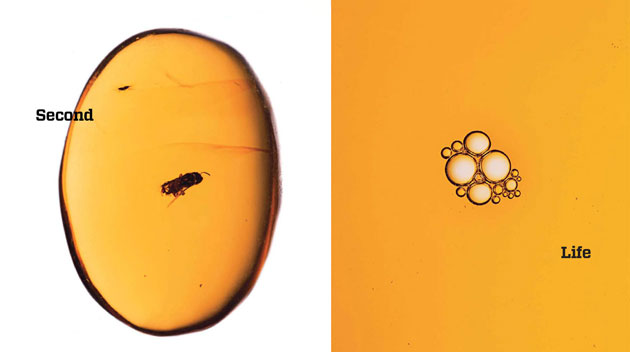
years. It started with a chunk of fossilized resin from the Dominican Republic. Trapped
inside was an extinct breed of stingless bee. It was dead, of course, but Cano theorized
that microorganisms in the resin might simply be dormant. After all, he reasoned, some
single-celled creatures are known to enter a hibernation-like state and survive for years
with no air or food. Still, few believed that anything could survive after lying dormant
for so long.
Cano wanted to find out. He took the contents of the ancient bee's stomach, suspended
it in saline, and spread it on a growth medium. Amazingly, something woke up and began
propagating in the petri dish. Cano identified it as a bacterial spore related to the
modern Bacillus sphaericus, which is used to kill mosquito larvae.
Cano's discovery changed science's understanding of just how extraordinarily
resilient microorganisms are. "They're the quintessential survivors," he
says. "They started when the planet was born, they're going to stay around until
the planet is dead, and then they'll just go somewhere else." After publishing
the results of his experiment in Science, Cano found himself the center of national
attention from scientists and eventually the media. This was the closest humanity had come
to the discovery imagined in Jurassic Park.
Over the course of the next year, Cano would crack open several more pieces of amber and
bring hundreds of strains of ancient bacteria back to life in his lab. In the process, he
began to think there might be a practical use for these creatures. He launched a company,
Ambergene, to explore potential biomedical applications. The premise for the venture was
that ancient organisms might have antibiotic potential—they'd been out of the
ecosystem for so long that nothing today would have a resistance to them. At the time, the
approach—dubbed natural product discovery—was very much in vogue. Major players like Merck
and Eli Lilly were making serious investments.
Creating a life-saving drug was appealing. Fabulous riches would be a nice side effect.
"Altruism's great, but it's not that great," Cano says. He possessed
the only known samples of these strains, and he patented his revivification process to
further cement his control over them. As the cofounder, part-owner, and chief scientific
officer of Ambergene, Cano stood to earn a hefty chunk of any windfall that might result.
To reassure potential investors, Ambergene's board of directors decided to confirm
Cano's claims of reanimation. He wasn't the first to attempt to bring tiny
beings back to life in this manner. But every previous reported success turned out to be a
case of modern bacteria contaminating the amber during the extraction process.
How to Reanimate Prehistoric Microorganisms
Raul Cano proved that single-celled creatures like yeast and bacteria can be revived after
lying dormant in amber—fossilized tree resin—for tens of millions of years. Here's
how it's done.
STEP 1
Procure
Amber is found all over the world and can be bought from brokers (or even on eBay). Prices
can reach into the thousands of dollars, depending on size and biological matter trapped
inside. (Chunks with insects are most likely to yield microorganisms.)
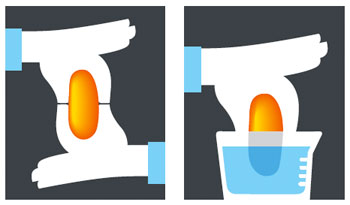
STEP 2
Sterilize
To avoid contamination by modern microbes, sterilize the lab environment and clean the
amber thoroughly by soaking it in disinfectants, giving it an ultrasonic wash, then
dousing it in ethanol and lighting it on fire.
STEP 3
Shatter
To open the amber, place the sample in liquid nitrogen, where it will freeze and become
brittle. At this point, the specimen can be shattered by dousing it with sterilized warm
saline. It can also be smashed, ground up, or drilled.
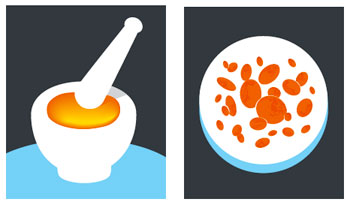
STEP 4
Grow
Spread the contents of the amber onto a petri dish containing a microorganism food like
starch or soy. Not every piece of amber harbors dormant microorganisms—if the petri dish
yields nothing, go back to step 1 and try again.
Illustration: Noma Bar
"I was very skeptical," says Chip Lambert, a microbiologist tapped by Ambergene
to try to duplicate Cano's results. The company provided him with amber and all of
Cano's sterilization and extraction protocols. Lambert doubled all of the cleaning
processes and added some of his own. He was still able to duplicate Cano's discovery.
Cano didn't mind the company checking his work if it helped Ambergene win financing.
He ended up being impressed with Lambert's efforts. "We became friends,"
Cano says. "I enjoy his company. Besides working with him on some of his projects,
we'd socialize, get dinner, maybe grab a beer." (Another team of researchers
working with Cano has also been able to duplicate the results.)
In April 1995, during his amber-cracking spree, Cano made another important discovery. A
piece of fossilized resin from Burma yielded something that looked very similar to
Saccharomyces, brewer's or baker's yeast. This single-celled fungus feeds on
sugars and reproduces frequently—if it has enough to eat, a culture can double in
population in 90 minutes. "Yeasts are found in all kinds of vegetable matter—plants,
fruits, stuff like that," Cano says. "It was fortunate for that yeast to be
there at the time so it could become part of history."
Cano was fascinated by his find. Unfortunately, this ancient strain of yeast didn't
have commercial applications that Ambergene could exploit. And none of Cano's other
discoveries were yielding biomedical breakthroughs, either. "We did find two or three
microorganisms that produced some new chemical compounds," Cano says. "But they
were never pursued, because the company was broke. I was really disappointed."
Ambergene folded in 1997. Cano wentback to his lab and pursued other research, like
testing petroleum-degrading bacteria in sand dunes. That project scored enormous grants
for Cal Poly, as did many of Cano's other research efforts. But he couldn't
forget his brush with fame and fortune. "It was a scientific wild ride, like an E
ticket at Disneyland," he says. "As you grow older, the thrill of the hunt
becomes more and more acute, at least for me." Meanwhile, his ancient yeast—suspended
in glycerol and nutrients—lay dormant in a deep freeze.
In March 2006, chip Lambert happened to meet a guy named Peter Hackett at a ski resort in
Lake Tahoe, California. Hackett is a Northern California pub owner and brewer. Before
long, the conversation turned to ancient yeast. "It started as a very casual,
noncommittal, you-must-be-out-of-your-mind conversation," Hackett recalls. "He
told me the story of how Cano revived the yeast, how it resembled brewer's yeast. And
then he said, 'Wouldn't it be interesting if we could make beer with
it?'"
Lambert and Cano had toyed with the idea for 12 years. Before Ambergene went under, the
company made a batch on a lark. "We called it Jurassic Amber Ale or T-Rex Lager or
something, and it was pretty good," Cano says. It was served at his daughter's
wedding, and they even sent some to theJurassic Park 2 cast party. That experiment had
Cano and Lambert itching to release a beverage commercially. But they wanted it to be
something respectable.
"Brewing beer is a biotechnological process," Cano says. "I know the
essentials; I've taught it in classes. But the skills you need to actually make a
quality beer? I had no clue." They needed a professional brewer to take their yeast
for a serious test drive. But unable to interest one, they had put the idea on ice.
Hackett, 44, was a cocky upstart in the microbrew world, known for unique recipes like
Bushwacker Wheat (made with tangerines, blackberries, and sun-dried mandarins). He
hadn't really wanted to spend a cold, miserable afternoon discussing yeast from the
Eocene. "But Chip is a very persistent man," Hackett says. "It was the only
way I could get him to leave me alone." After some cajoling, the brewer agreed to try
making a batch of beer with Cano's yeast.
But Hackett had his doubts about the 45 million-year-old Saccharomyces. Beer is the result
of a chemical process that takes place when yeast gobbles up sugars and excretes carbon
dioxide and alcohol. The flavor depends heavily on the type of Saccharomyces doing the
eating, and very few strains perform well in the hostile anaerobic conditions inside a
brewing tank. "It requires a robust cell," Hackett says. "My boss is a
single-celled organism. If it's not happy, it will let me know."
Hackett combined the yeast with all the other ingredients that make up his popular Rat
Bastard pale ale recipe, so he could easily taste its distinguishing characteristics.
During the brewing, the ancient yeast's behavior was unusual, to say the least.
"It ferments violently at the start," Hackett says, "then it falls out of
suspension and the beer becomes almost clear." From a brewer's perspective, its
behavior was schizophrenic: It began like a yeast used in ales, floating at the top. Then
it began to act like yeast used in slow-fermenting lagers, settling to the bottom of the
tank but not going dormant.
Normally, Hackett ends the primary fermentation process by "crashing the
tank"—lowering the temperature to shock the yeast into dormancy. But that didn't
work on Cano's yeast. "It was just sitting on the bottom and nibbling on the
sugar like a couch potato," Hackett says. A strain that had survived 45 million years
in suspended animation was not about to go quietly.
Hackett was prepared to pour the batch down the drain if it tasted awful. But he
discovered that the flavor of the resulting ale was unique, and not in a bad way. It was
light and crisp with a citrusy, gingery tang. It was definitely worth exploring further.
The brewer began experimenting with the ancient strain. He indulged its idiosyncratic
behavior, letting it ferment for an extra month in a cold storage tank. He modified the
hops, a plant that adds a characteristic bitterness to beer, to complement the flavor
imparted by the yeast.
Cano's Saccharomyces coupled with Hackett's know-how to yield a very tasty
libation, which is now made and distributed under the name Fossil Fuels Brewing Company.
"We won the lottery," Hackett says. "It's such a random thing. A yeast
cell, captured in amber, found by a mad scientist. For it to perform well, for it to
perform uniquely ... I wouldn't have bet on it."
Fossil Fuels pale ale caused a stir among beer aficionados like William Brand, a former
critic with The Oakland Tribune who raved about it on his blog. He noted its "light
copper color and an intense clove aroma." He liked its sweetness and the
"intriguing, very odd spicy note" in the finish.
Celebrator Beer News described the ale as having a "complex and well-developed taste
profile" with "fruity flavor characteristics and just a touch of lemony
sweetness. The fact that it is made with such old yeast is fascinating, and given how good
the beer is, no mere novelty."
A 5-gallon glass jug containing hundreds of millions of Cano's yeast cells is sitting
on the back porch of Hackett's brewpub in Guerneville, California, 70 miles north of
San Francisco. Every half-hour or so, Hackett goes outside and shakes it up a bit. When
the sun warms the contents of the jug to 70 degrees Fahrenheit, it'll be ready.
Hackett has been stirring malted barley into 150-degree water in an enormous stainless
steel tub. The hot water will break down the starch in the grain, turning it into a sugary
substance called wort, which is then diluted, boiled, and transferred to a fermentation
tank. When the jar of yeast has warmed up sufficiently, Hackett dumps it into the tank,
where it begins to gobble up the wort.
Normally, Hackett could reuse this yeast after separating it from the freshly brewed batch
of beer. New characteristics may begin to present themselves as the tiny fungi go through
tens of thousands of generations. "Over time, genetic drift can occur," Hackett
says. "It mutates and evolves."
But for Fossil Fuels' brew, Cano prefers to create new colonies that are as close as
possible to the original generation he reawakened from the chunk of amber. His yeasty
beasties may not have made him a pharmaceutical millionaire, but he has finally discovered
a use for them, and he wants to stay involved in the brewing process.
As Hackett finishes preparing his latest batch, Cano arrives. He has driven up from San
Luis Obispo to get a pony keg of pale ale for his own personal use. And Lambert has come
up from the East Bay. The scientists sit on stools as Hackett brings out pints of their
beer, as well as fries, shrimp, and egg rolls hot from the brewpub's kitchen.
They're soon ready for a second round of beer.
Fossil Fuels Brewing will start selling its beer in pubs and restaurants throughout
California this fall. The company is creating beer-tap handles with hunks of amber
embedded in the tip. A bigger brewery—one capable of bottling the beer when they're
ready to put it on store shelves—has been enlisted to take on the commercial production
duties.
Cano is delighted with the burgeoning success of Fossil Fuels ale. It'll earn him a
little bit of money, and every pint or bottle sold could kick off a conversation about his
momentous discovery 14 years ago. His only worry is that the unfiltered nature of this
beer means that some of his yeast will invariably settle to the bottom of the glass or
bottle, and an unscrupulous brewer could collect that and use it in another beer. The
microbiologist has applied for a patent on his strains and has sequenced the genomes so he
can tell if someone else has stolen it. "I am the keeper of the family jewels,"
Cano says. He isn't about to let them fall into the wrong hands.
Correspondent Erin Biba (twitter.com/erinbiba) wrote about GPS applications in issue
17.02.



5968
days inactive
5968
days old
0 comments
1 participants
participants (1)
-
 alboyce@comcast.net