24 Sep
2008
24 Sep
'08
6:04 a.m.
In case the screen print does not come across:
Cheers!
~Brian
Ancient Yeast Reborn in Modern Beer
Eric Bland, Discovery News
Sept. 23, 2008 -- Trapped inside a Lebanese weevil covered in ancient
Burmese amber
<http://dsc.discovery.com/news/2008/04/11/amber-feather-dino.html> , a
tiny colony of bacteria and yeast has lain dormant for up to 45 million
years. A decade ago Raul Cano, now a scientist at the California
Polytechnic State University, drilled a tiny hole into the amber and
extracted more than 2,000 different kinds of microscopic creatures.
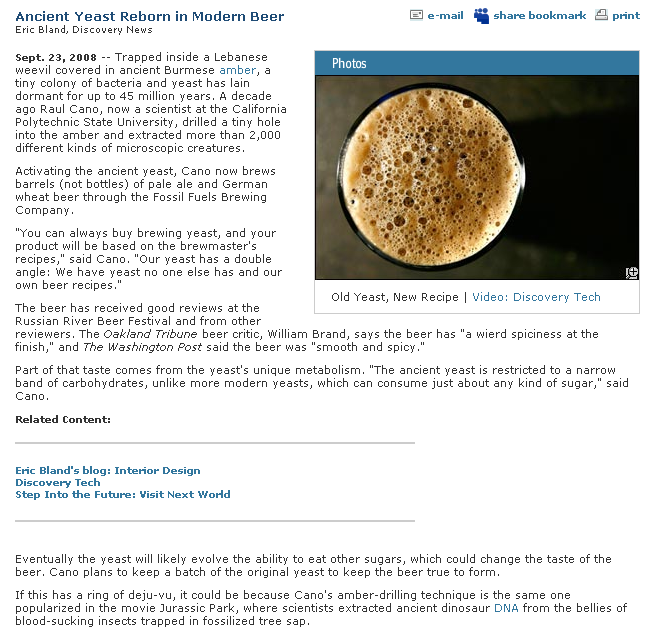
Activating the ancient yeast, Cano now brews barrels (not bottles) of
pale ale and German wheat beer through the Fossil Fuels Brewing Company.
"You can always buy brewing yeast, and your product will be based on the
brewmaster's recipes," said Cano. "Our yeast has a double angle: We have
yeast no one else has and our own beer recipes."
The beer has received good reviews at the Russian River Beer Festival
and from other reviewers. The Oakland Tribune beer critic, William
Brand, says the beer has "a wierd spiciness at the finish," and The
Washington Post said the beer was "smooth and spicy."
Part of that taste comes from the yeast's unique metabolism. "The
ancient yeast is restricted to a narrow band of carbohydrates, unlike
more modern yeasts, which can consume just about any kind of sugar,"
said Cano.
Related Content:
---
Brian Hatcher
Sr. Master Scheduler
C.P.I.M.
Email: brian_hatcher(a)Xiotech.com
Office: 952 983 2466
Fax: 952 983 2488
Xiotech Corporation
6455 Flying Cloud Drive
Eden Prairie, MN 55344
www.xiotech.com : www.xiotech.com/demo : Toll-Free 866 472 6764
________________________________
Eric Bland's blog: Interior Design
<http://blogs.discovery.com/news_interior_design/>
Discovery Tech <http://dsc.discovery.com/technology/index.html>
Step Into the Future: Visit Next World
<http://dsc.discovery.com/tv/next-world/next-world.html>
________________________________
Eventually the yeast will likely evolve the ability to eat other sugars,
which could change the taste of the beer. Cano plans to keep a batch of
the original yeast to keep the beer true to form.
If this has a ring of deju-vu, it could be because Cano's amber-drilling
technique is the same one popularized in the movie Jurassic Park, where
scientists extracted ancient dinosaur DNA
<http://science.howstuffworks.com/dna.htm> from the bellies of
blood-sucking insects trapped in fossilized tree sap.
Cano's original goal was to find ancient microscopic creatures that
might have some kind of medical value, particularly pharmaceutical
drugs.
While that particular avenue of research didn't yield significant
results, the larger question of how microscopic creatures survived for
millions of years could help scientists understand certain diseases,
said Charles Greenblatt, a scientist at Hebrew University in Jerusalem
who studies ancient bacteria.
"We've got cases of guys who contracted [tuberculosis] during World War
II and lived with it for 60, 70 years," said Greenblatt. "Then suddenly
they get another disease, the TB wakes up from its dormancy and kills
them."
Inducing dormancy could be a new way to fight disease and infection,
said Greenblatt. Instead of outright killing infectious creatures,
doctors could instead put them to sleep. The infection would still be
present in the patient's body, but it wouldn't hurt the patient.
Neither Cano nor Greenblatt can say what the upper limit for hibernating
yeast or bacteria is; it could be hundreds of million years. But while
other scientists work on that, Cano plans to spend his time tossing back
a few cold ones <http://recipes.howstuffworks.com/beer.htm> , and hoping
others will too.
"We think that people will drink one beer out of curiosity," said Cano.
"But if the beer doesn't taste good no one will drink a second."